
How to Write Resume for Accountant Job
How to Write Resume for Accountant Job
Creating a strong accountant resume is one of the most important steps in securing a role in the finance and accounting industry. Employers are looking for candidates who can demonstrate accuracy, analytical thinking, and a solid understanding of financial processes. If you want to stand out, you need to understand exactly how to write resume for accountant job applications in a way that is both ATS friendly and appealing to hiring managers. Understanding the accountant job description is crucial, as tailoring your application to match the specific requirements and keywords listed will significantly improve your chances of success.
In this guide, you will learn how to structure your resume, what content to include, and how to tailor it for different accounting roles. There are many types of accounting jobs available, so it’s important to customize your resume for each accountant job application to highlight the most relevant skills and experience. You will also find accountant resume examples, tips on accounting resume format, and a simple CV template you can adapt.
Accountant Resume: What Recruiters Expect
Choosing the right accounting resume format is essential for readability and ATS compatibility. A clean and structured layout helps employers quickly find the information they need.
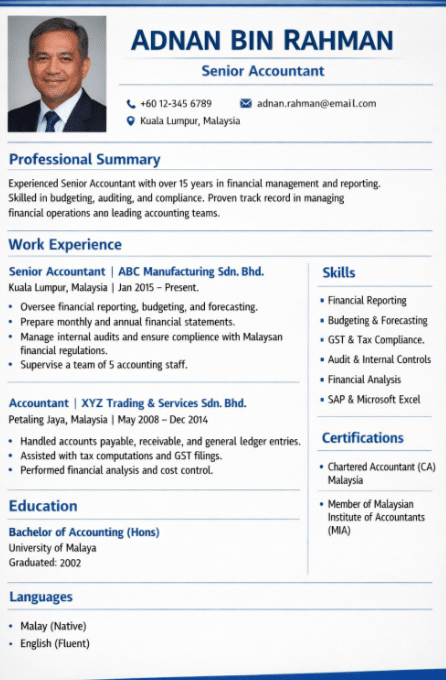
A standard accounting resume format includes the following sections:
Contact information placed at the top of the page with your name, phone number, and email address.
Resume objective or professional summary that highlights your experience and goals.
Work experience detailing your previous roles and achievements.
Relevant accounting skills that match the job description.
Education including your accounting university, degree (such as Bachelor of Business Administration), graduation date, and relevant coursework like corporate finance to strengthen your qualifications.
Accounting certifications that strengthen your credibility.
Additional sections such as languages or technical tools if applicable.
Using a professional CV template ensures your resume looks polished and organized. Using an accounting resume template, especially those created by certified professional resume writers, helps ensure your resume is well-structured, effective, and presents your qualifications in the best possible light.
Choosing the Right Resume Format and Template
Selecting the right resume format and template is a crucial first step in crafting an effective accountant resume. Hiring managers often prefer a reverse-chronological format, which places your most recent and relevant experience at the top, making it easy to see your career progression and achievements. This format is especially effective for a senior accountant resume or a certified public accountant (CPA) resume, as it highlights your leadership roles and advanced responsibilities.
Alternatively, a combination format can be beneficial if you want to emphasize both your technical skills and work history. This approach is ideal for accountants who have a diverse skill set or are transitioning between roles. Using a professional resume template tailored for accountants ensures your document is organized, visually appealing, and aligned with industry standards. Look for templates that provide clear sections for certifications, such as Certified Public Accountant CPA, and allow you to showcase your expertise in line with the job description.
No matter which format you choose, make sure your accountant resume is easy to read, ATS-friendly, and customized for the specific role you’re targeting. A well-chosen template can help you present your qualifications in the best possible light and make a strong impression on hiring managers.
Resume Objective for Accountant
Your resume objective plays a key role in making a strong first impression. It should be concise yet impactful, clearly stating your experience and career goals.
A good resume objective for an accountant focuses on your strengths and how you can contribute to the company. For example, you might highlight your experience in financial reporting, compliance, or cost management.
An effective resume objective can position you as a strong candidate even before the recruiter reads the rest of your resume.
Relevant Accounting Skills to Include
Including relevant accounting skills is critical when writing an accountant resume. These skills help your resume pass applicant tracking systems and show employers that you meet the job requirements.
Technical skills should include financial reporting, accounts payable and receivable, tax preparation, budgeting, auditing, budget analysis, cash flow management, and budget forecasting, as well as proficiency in accounting software such as Excel or SAP. Financial expertise, financial accuracy, and the ability to ensure financial accuracy in all financial processes are essential for maintaining compliance and reliability in financial reporting. Familiarity with ERP software is also valuable for effective financial data analysis.
Soft skills are equally important and should include analytical skills to analyze complex financial data, communication skills to convey financial information effectively, and time management skills to meet deadlines for financial reporting. These, along with problem solving and attention to detail, are crucial for success in accounting roles. Financial decision making is also a key relevant skill, enabling accountants to assess risks and make informed choices that support organizational objectives.
Combining both technical and soft skills demonstrates your relevant skills and financial expertise to employers.
Action Verbs and Quantifiable Achievements for Accountants
To make your accountant resume truly stand out, it’s important to use strong action verbs and highlight quantifiable achievements throughout your work experience section. Action verbs such as “analyzed,” “audited,” “reconciled,” “managed,” and “implemented” clearly convey your active role in financial processes and demonstrate your impact within accounting teams.
Pair these verbs with specific, measurable results to show the value you brought to previous employers. For example, a staff accountant resume might include statements like, “Prepared and reviewed quarterly financial statements, ensuring 100% compliance with accounting principles and regulatory standards,” or “Streamlined month-end closing processes, reducing reporting time by 20%.” A certified management accountant could highlight achievements such as, “Led financial analysis projects that identified cost-saving opportunities, resulting in a 15% reduction in departmental expenses.”
By quantifying your accomplishments, you provide concrete evidence of your expertise in financial statements, financial analysis, and accurate financial management. This approach not only strengthens your accountant resume but also helps you stand out in a competitive job market.
Accountant Resume Examples by Job Role
Different accounting roles require different levels of experience and specialization. To maximize your chances of success, always review the accountant job description and use the correct job title to tailor your resume for each role. Highlighting a proven track record in areas such as financial analysis, compliance, or tax preparation, as well as showcasing process improvements you have implemented, will make your application stand out. A results-focused work history section, featuring quantifiable achievements and clear metrics, is essential for demonstrating your impact and strengthening your credibility. Tailoring your resume based on the position you are applying for will improve your chances of success.
Senior Accountant Resume
A senior accountant resume should highlight leadership experience and advanced financial responsibilities. In addition to managing financial statements, overseeing audits, and mentoring junior staff, you should demonstrate your experience managing financial reporting and preparing financial reports for corporate clients. Employers expect senior candidates to demonstrate strategic thinking and decision making abilities. It is also important to highlight a clear promotion path and relevant accounting responsibilities to showcase your career growth and expertise.
Junior Accountant
An entry level accountant resume is essential for recent graduates or those with limited experience, as it should be carefully tailored to highlight relevant skills and make a strong first impression in accounting job applications. A junior accountant resume is typically for entry level candidates or recent graduates. It should focus on academic achievements, internships, and foundational accounting knowledge. Even without extensive experience, showcasing your willingness to learn and your understanding of accounting principles can make a strong impression.
Payroll Accountant Resume
A payroll accountant resume should emphasize your ability to manage payroll processes accurately. This includes calculating salaries, handling tax deductions, ensuring compliance with labor laws, and using payroll systems efficiently.
Fixed Asset Accountant Resume
A fixed asset accountant resume should demonstrate your expertise in managing company assets. This includes tracking asset lifecycles, calculating depreciation, and ensuring accurate financial reporting related to capital expenditures.
Fund Accountant Resume
A fund accountant resume is more specialized and often required in investment firms. It should highlight experience in fund accounting, net asset value calculations, and financial reporting for investment portfolios. Knowledge of regulatory requirements is also important in this role.
Accounting Certifications That Add Value
Accounting certifications play a significant role in strengthening your resume. They demonstrate your professional competence and commitment to the field.
Popular certifications include Certified Public Accountant CPA, ACCA, and CIMA. Having these credentials can significantly improve your chances of securing interviews, especially for senior level roles.
Employers often prioritize candidates with certifications because they indicate a higher level of expertise and credibility.
Accountant Resume Sample and CV Template
Using an accountant resume sample can help you understand how to present your information effectively. You can download free resume templates specifically designed for accountant jobs, including templates for accounting assistant resume, accounting intern resume, cost accountant resume, and general ledger accountant resume. A well structured CV template ensures consistency and professionalism.
A typical accountant resume sample includes your contact details, a strong resume objective, relevant work experience, key accounting skills, educational background, and certifications. Each section should be clearly defined and easy to read.
When using a CV template, make sure to customize it according to the job description. Avoid copying content directly and instead tailor your resume to highlight your unique experience.
Resume Optimization: Tailoring Your Resume for Each Job
Optimizing your accountant resume for each job application is essential for catching the attention of hiring managers and passing applicant tracking systems (ATS). Start by reading the job description carefully and identifying the key skills, qualifications, and accounting software mentioned. Incorporate these keywords naturally into your resume summary, work experience, and skills sections.
For example, if the job description emphasizes experience with a specific accounting software or requires a certified public accountant (CPA) or certified internal auditor (CIA) credential, make sure these are prominently featured in your resume. Highlight your proficiency with relevant tools and your understanding of industry standards. If you’re applying for a senior accountant or accounting manager position, showcase your leadership experience and ability to manage complex financial data.
Customizing your accountant resume for each application demonstrates your attention to detail and genuine interest in the role. It also increases your chances of making it through ATS filters and impressing hiring managers with your tailored approach.
Keyword Usage in Accountant Resumes
Strategic keyword usage is vital for ensuring your accountant resume is noticed by both applicant tracking systems and hiring managers. Incorporate relevant keywords that reflect your expertise and align with the job requirements. For example, include terms like “accounting software,” “financial analysis,” “budgeting,” “financial reporting,” and “tax preparation” to highlight your technical skills.
Industry-specific keywords such as “generally accepted accounting principles (GAAP),” “tax compliance,” and “audit procedures” can further demonstrate your knowledge and professionalism. If you’re applying for a tax accountant resume, be sure to mention “tax planning,” “tax compliance,” and “tax returns.” For a forensic accountant resume, use keywords like “fraud detection,” “financial investigation,” and “internal controls.”
Use these keywords naturally within your resume, especially in your summary, skills, and experience sections. This not only helps your resume pass ATS filters but also reassures hiring managers that you possess the accounting principles and expertise required for the role.
Tips to Improve Your Accountant Resume
Writing a high quality accountant resume requires attention to detail and strategic keyword usage. Including terms such as accountant resume examples, accounting resume format, and resume examples can help improve visibility in ATS systems.
To stand out, highlight your proven track record and relevant skills, tailoring them to the specific job description. Demonstrate your financial expertise by showcasing your qualifications, accomplishments, and ability to manage financial tasks with accuracy and compliance. Accountant resumes are strongest when they connect financial expertise to accuracy and results.
Consider using templates or seeking guidance from certified professional resume writers to ensure your resume is well-structured, effective, and professional. An accountant’s resume should be clean, results-focused, and easy to scan, clearly showcasing accuracy, compliance, and measurable financial impact.
Quantifying your impact on your resume provides concrete proof that you’re an asset to the company. Use action verbs in your work history section to enhance clarity and make your achievements stand out.
Keep your resume concise and focused, ideally within one or two pages. Use clear language and avoid unnecessary jargon. Quantify your achievements whenever possible to demonstrate your impact, such as improving efficiency or reducing costs.
Always tailor your resume for each job application. This shows employers that you understand their requirements and are genuinely interested in the role.
Common Mistakes to Avoid on Your Accountant Resume
Avoiding common mistakes can make a significant difference in the effectiveness of your accountant resume. First, always proofread your resume to eliminate typos and grammatical errors, as these can undermine your professionalism in the eyes of hiring managers. Second, steer clear of generic statements, focus instead on specific achievements and examples that showcase your accounting expertise.
Don’t forget to include relevant certifications, such as Certified Public Accountant (CPA) or Certified Management Accountant (CMA), as these credentials are highly valued for both junior accountant and senior accountant roles. Make sure to list your proficiency with essential accounting software, such as QuickBooks, SAP, or Excel, to demonstrate your technical skills.
Keep your resume concise and well-organized, using clear headings and bullet points to make information easy to find. Whether you’re applying for an accounting manager, junior accountant, or senior accountant position, a well-crafted accountant resume that avoids these common pitfalls will help you stand out and advance your career.
Final Thoughts
Understanding how to write resume for accountant job applications can significantly improve your chances of getting hired in today’s competitive market. Always start by carefully reviewing the accountant job description and tailor your resume for each accountant job application to ensure you address the specific skills and responsibilities required. By using the right accounting resume format, clearly presenting your experience, and highlighting relevant accounting skills, you position yourself as a strong and credible candidate. Whether you are applying for a junior accountant role or preparing a senior accountant resume, tailoring your content to match the job requirements is essential.
Do not forget to include a strong resume objective, showcase your accounting certifications such as Certified Public Accountant CPA, and refer to accountant resume examples to continuously improve your document. Using an accounting resume template can help ensure your resume is well-structured, professional, and easy for recruiters to review. A well structured resume combined with a professional CV template can make a powerful first impression and help you stand out from other applicants.
If you are ready to take the next step in your accounting career, now is the perfect time to put your resume into action. Apply accountant jobs at Caltrix today and connect with opportunities that match your skills and career goals.
FAQs
How to write a resume as an accountant?
Use a clear format with contact details, a resume objective, work experience, relevant accounting skills, education, and certifications. Focus on measurable achievements, include job specific keywords, and tailor your resume to the accounting role you are applying for.
What is a good objective for an accountant’s resume?
A good resume objective for an accountant is a short statement that highlights your experience, key accounting skills, and career goals. It should show how you can add value, for example by mentioning financial reporting, budgeting, or compliance, while aligning with the job you are applying for.
What are accounting skills for resume?
Accounting skills include financial reporting, budgeting, tax preparation, accounts payable and receivable, auditing, and proficiency in Excel or accounting software, along with soft skills like attention to detail, accuracy, and problem solving.

Alfred Ang
Alfred has led the company in helping over 500 SMEs successfully transition to digital platforms. With expertise in cloud accounting software implementation and other tech stacks. Alfred empowers businesses to access real-time, accurate financial data for informed decision-making. As a Chartered Accountant (CGMA, ACMA, and MIA member), he is driven by the mission to streamline traditional accounting processes. Alfred’s accomplishments include winning the Xero Award for Medium Accounting Partner of the Year in 2024.