Xero for SaaS and Software Subscription Businesses Malaysia
You landed your first annual subscription customer last month. They paid RM6,000 upfront, you posted it as revenue, and your financial statements looked strong. A few months later your accountant tells you that half of that RM6,000 does not belong in this year’s accounts. You have been recognising revenue before earning it, your balance sheet is missing a liability, and if you are planning to raise investment, these accounts will not hold up in due diligence.
This is the most common accounting mistake SaaS founders make in Malaysia, and it is not their fault. Traditional accounting software is built around the idea that a sale happens once and payment follows shortly after. Software subscription businesses do not work that way, and neither does the accounting. Xero saas malaysia, when configured correctly for how subscription revenue actually works, handles recurring billing, deferred revenue recognition, and the real time financial reporting your finance team and investors need from a cloud accounting software that scales with your business.
The Revenue Recognition Problem Every SaaS Business in Malaysia Needs to Understand
Why Annual Contract Cash Cannot Go Straight Into Your Revenue Account
Under MFRS 15, Malaysia’s financial reporting standard for revenue recognition, income is recognised when a performance obligation is satisfied, not when cash arrives. For a SaaS annual contract, the performance obligation is delivering the software for 12 months. That means only one-twelfth of the annual contract value belongs in each monthly income statement. The remaining eleven-twelfths sit on the balance sheet as deferred revenue, a liability representing what the business still owes the customer in future service months.
Early stage SaaS companies almost always skip this. All annual contract cash goes into revenue the same month it lands. The business appears profitable in months with strong new sales and flat in months without renewals, and the true recurring revenue is invisible in the accounts. For growing businesses preparing for investment from Malaysian VC funds or applying for MDEC and Cradle grants, financial statements carrying this error cannot support the ARR reporting and MRR metrics you are presenting to investors. Getting revenue recognition right now avoids a painful and time consuming correction process before your next funding round.
Separate Performance Obligations: When Your Contract Has More Than One Element
The picture gets more complex when your contracts bundle multiple elements together. A SaaS package that includes a one-time setup fee, monthly software access, and ongoing support creates separate performance obligations under MFRS 15, each element that a customer could purchase and use independently must have its own revenue recognition timeline. The implementation fee may be recognised on completion. The subscription is recognised monthly. Without accounting entries that reflect this structure, your financial statements are misstated from the first contract you sign, and untangling the accounting entries later is a significant project for your accountants.
How Xero Accounting Software Actually Handles SaaS Revenue Recognition
Setting Up Deferred Revenue in Xero and What Changes After
Xero does not automatically detect that an incoming payment is a deferred annual contract. What it does provide is a chart of accounts you can configure correctly. You create a deferred revenue liability account. When an annual contract payment arrives, your team posts it to that account rather than straight into income. Each month, a manual journal moves the recognised share from deferred revenue into the revenue account. Set up as a recurring journal in Xero, this runs automatically without manual data entry, removes human error from the monthly close process, and keeps your accounting records current throughout the year.
The balance sheet then shows exactly what the business owes in future service months. The profit and loss shows actual earned recurring revenue each period. Month-end takes minutes rather than hours. This is not complex once the chart of accounts is structured correctly, the work is in the setup, and after that Xero handles the accounting entries automatically every month.
What Xero Does Natively Versus Where You Need an Add-On
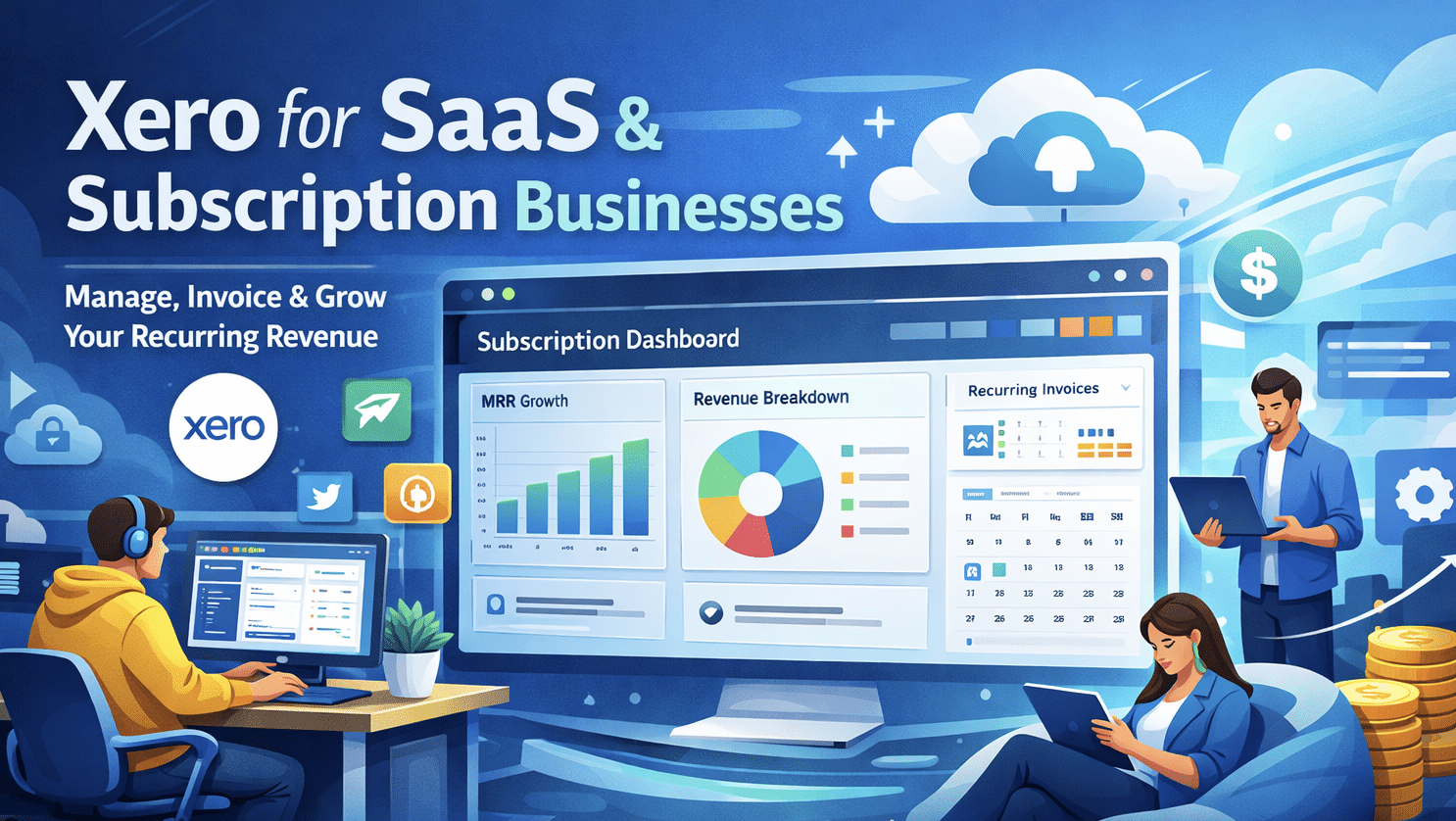
Being direct about this saves a lot of wasted time, Xero does not have native MRR and ARR reporting dashboards. If your investors expect live ARR reporting, churn metrics, and cohort analysis alongside standard financial statements, you need an add-on from the Xero App Store. Tools such as ScaleXP and Flowrev connect directly to Xero, automate deferred revenue recognition, and surface subscription metrics in real time without manual tasks or duplicate data entry between your billing system and accounting software. For most early stage SaaS businesses, the core Xero features cover the essentials, bank feeds that match subscription payments daily, recurring invoices for subscription billing, expense claims, supplier bills, payroll, and real time financial data in the standard reports. The add-ons become important as reporting requirements grow.
SST on Digital Services, E-Commerce Platforms, and LHDN E-Invoicing
Malaysian SaaS businesses providing digital services to local customers are subject to SST at 8 per cent on taxable digital service revenue. Configure Xero with the correct SST tax codes from the start and every invoice raised to a Malaysian customer carries the right tax treatment automatically. Your bimonthly SST return data pulls from the accounting system rather than being assembled from bank statements and spreadsheets at tax time.
If you are billing through Stripe or e-commerce platforms, connecting those platforms to Xero eliminates the manual entry involved in posting individual subscription payments. Transaction data flows from your billing system into Xero automatically, bank feeds reconcile incoming payments against invoices, and credit notes for cancellations or refunds are handled consistently without creating reconciliation problems. When a customer cancels mid-cycle, the credit note reverses the correct portion of recognised revenue and adjusts the deferred revenue balance, your accounting records stay accurate even when the contract schedule changes.
LHDN’s MyInvois e-invoicing mandate is extending to more Malaysian businesses through 2025 and 2026. SaaS companies billing Malaysian business customers will come into scope as the revenue thresholds lower. Configuring Xero with MyInvois e-invoicing now means your invoicing workflow is already compliant when your threshold is reached, rather than requiring a last-minute change that disrupts your billing operations. Cloud based accounting software with e-invoicing built in is not a nice-to-have for a growing SaaS business, it is a compliance requirement that is coming regardless of when you choose to address it.

Cash Flow, ARR Reporting, and the Financial Data Growing Businesses Actually Need
One of the things SaaS founders get wrong about cloud accounting software is thinking its main job is bookkeeping. The real value of a correctly configured Xero setup for a SaaS business is what it tells you about the financial health of your business, not just what cash is in the bank, but what revenue is genuinely earned, what obligations are outstanding, and whether your business cash flow can support the growth decisions you are about to make.
Xero’s real time financial reporting gives you profit and loss, balance sheet, and cash flow statements built from live, reconciled data. The budgeting tools let you model scenarios against actual recurring revenue rather than guesses. For finance teams managing the gap between annual contract cash received upfront and the monthly cost of delivering the service, this visibility is what separates proactive financial management from reacting to problems after they appear in the bank account.
For SaaS businesses with international customers, Xero’s multi-currency support handles invoices, payments, and bank reconciliation across currencies without maintaining separate records. Supplier bills, expense claims, and payroll all sit in the same accounting system, so your accountants and financial advisors have a complete picture of the business without assembling data from multiple tools.
What Happens When You Discover the Problem in Due Diligence
A Kuala Lumpur SaaS company offering workforce automation software had been running on Xero for 18 months. Bank feeds were connected, invoices were going out on time, and expense claims were being processed. On the surface, the accounting looked clean. The problem surfaced during Series A preparation, when the founders noticed their monthly financial statements showed wild revenue swings that bore no relationship to the stable ARR growth they were presenting to investors. Some months showed extraordinary revenue. Others were nearly flat. The accounts and the pitch metrics told completely different stories.
The cause was straightforward, every annual contract had been recognised in full on the day of payment. There was no deferred revenue on the balance sheet. Twelve months of accounting entries needed to be corrected before the financial statements could support the investment round. CALTRiX audited the Xero setup, added a deferred revenue liability account, rebuilt the historical entries across all active annual contracts, and configured recurring monthly journals for correct recognition going forward. A tracking category separated subscription revenue from one-off professional services income so both were visible in reporting independently.
By the time the founders entered due diligence, the financial statements matched the ARR figures in the pitch deck and the business’s financial health was clearly visible to investors. “We thought Xero was set up correctly because it looked tidy,” the founder noted. “It was only when someone looked properly at the chart of accounts that the problem became obvious. Getting it fixed before the round was the best money we spent that year.”
What CALTRiX Actually Fixes When Setting Up Xero SaaS Malaysia
Most SaaS businesses that contact CALTRiX are not in crisis. They are growing, they are using Xero, and things appear to be working fine. The issue is almost always the same, Xero has been set up as a generic small business accounting system rather than a subscription business. There is one revenue account, no deferred revenue tracking, no recurring journals, and no separation between subscription income and professional services or one-off sales. The accounting system is being used as a cash ledger rather than a tool that accurately reflects how a SaaS business earns its revenue.
The first thing we do is fix the revenue recognition foundation. That means rebuilding the chart of accounts with a proper deferred revenue liability account, setting up recurring monthly journals so annual contract income is recognised correctly without anyone touching it, and separating subscription revenue from professional services income so both are visible independently in reporting. For businesses with months of historical errors, we correct the prior period accounting entries before setting the system up correctly going forward. This is the work that makes everything else reliable.
The second piece is making the financial data useful for how SaaS founders and finance teams actually use it. That means connecting your billing platform, whether Stripe, a custom invoicing system, or e-commerce platforms, so payment data flows into Xero without manual entry. It means configuring tracking categories and the right App Store add-ons, such as ScaleXP or Flowrev, so your ARR reporting and recurring revenue metrics sit alongside your standard financial statements rather than living in a separate spreadsheet. And it means setting up the budgeting tools so cash flow modelling reflects real subscription revenue rather than guesses.
The compliance layer covers SST configuration for digital services revenue, LHDN MyInvois e-invoicing integration, and multi-currency setup if you are billing international customers. These are not optional extras, they are requirements that become painful to retrofit once the business is running at scale. Getting them right in the initial setup costs a fraction of what it costs to fix them under audit pressure.
We work with SaaS companies at every stage, from founders setting up Xero before their first paying customer to scaling businesses correcting years of misrecognised revenue before a funding round. If you recognise any part of the problem described in this article in your own accounts, the right time to fix it is before your next investor conversation, not after. Contact CALTRiX to get your Xero saas malaysia setup working the way a subscription business actually needs it to.
Frequently Asked Questions
Is Xero suitable for SaaS businesses in Malaysia?
Yes, but only when configured correctly for subscription accounting. Out of the box, Xero is a general-purpose cloud based accounting software that will not automatically handle deferred revenue or recurring revenue recognition. With the right chart of accounts, recurring manual journals, and billing platform integrations, Xero gives SaaS companies accurate real time financial reporting, clean deferred revenue tracking, and financial statements that reflect how a subscription business actually earns its income.
How does Xero handle deferred revenue for SaaS companies?
Xero handles deferred revenue through a dedicated liability account in the chart of accounts. When an annual contract payment arrives, it is posted to the deferred revenue account rather than recognised as income immediately. Monthly recurring manual journals move the earned portion into the revenue account each month. Over the contract period the full value is recognised correctly, the balance sheet reflects the remaining unearned obligation, and your financial statements match your actual recurring revenue rather than your cash timing.
Can Xero do MRR and ARR reporting natively?
Not natively. Xero does not have built-in MRR and ARR dashboards. For subscription metrics alongside financial statements, you need an add-on from the Xero App Store. ScaleXP and Flowrev both integrate directly with Xero and automate deferred revenue recognition while surfacing recurring revenue metrics. CALTRiX can configure the right add-on for your business alongside the core Xero setup.
Does SST apply to SaaS revenue in Malaysia?
Yes. Malaysian SaaS businesses providing digital services to local customers are subject to SST at 8 per cent on taxable digital service revenue. Xero can be configured with the correct SST tax codes so every invoice to a Malaysian customer is taxed correctly from the start, and your bimonthly SST return data is available directly from the accounting system rather than assembled manually at tax time.
When does LHDN’s e-invoicing mandate apply to SaaS companies?
Malaysia’s mandatory e-invoicing rollout through the MyInvois system is phased by revenue threshold. SaaS companies billing Malaysian business customers will fall within scope as thresholds lower through 2025 and 2026. Xero supports MyInvois e-invoicing integration, and configuring it before you reach your threshold means your billing workflow is already compliant when the obligation kicks in rather than requiring a disruptive last-minute change.

Alfred Ang
Alfred has led the company in helping over 500 SMEs successfully transition to digital platforms. With expertise in cloud accounting software implementation and other tech stacks. Alfred empowers businesses to access real-time, accurate financial data for informed decision-making. As a Chartered Accountant (CGMA, ACMA, and MIA member), he is driven by the mission to streamline traditional accounting processes. Alfred’s accomplishments include winning the Xero Award for Medium Accounting Partner of the Year in 2024.