

E-Invoicing Regulatory Updates Malaysia: Staying Compliant in 2026
Malaysia’s e invoicing regulatory updates Malaysia initiative marks one of the most comprehensive transformations in the country’s financial reporting landscape. Driven by the Inland Revenue Board (also known as the Revenue Board of Malaysia), this initiative modernizes invoicing, enforces transparency, and strengthens Malaysia’s tax administration management. The Malaysia Digital Economy Corporation (MDEC) plays a key role in promoting digital transformation and e-invoicing adoption through initiatives like the National e-Invoicing Initiative. By 2026, all businesses like large corporations, medium sized enterprises, smaller businesses, entrepreneurs, and even certain entities such as financial institutions and international organizations must issue validated e invoice documents for all domestic transactions and international transactions. To issue e invoice, businesses can use mechanisms such as the MyInvois Portal or API, which provide different options for transmitting and validating e-invoices.
The shift toward e invoices supports the growth of the digital economy, enhances tax compliance, and ensures that every business conducting business in Malaysia follows standardized, government-validated invoicing practices. Choosing the right e invoicing solution is essential to ensure compliance, streamline invoice processing, and adapt to evolving regulatory requirements.
The MyInvois Portal allows both supplier and buyer to request and retrieve e-Invoice data, highlighting its dual access functionality.
As enforcement actions strengthen, SMEs must understand the updated e invoicing requirements, the technical framework, the implementation timeline, and the operational changes needed for smooth implementation.
This article serves as a comprehensive guide to help SMEs stay up to date, ensure compliance, and confidently transition into Malaysia’s new invoicing era.
Introduction to E-Invoicing
E-invoicing, or electronic invoicing, is transforming the way businesses in Malaysia manage their invoicing processes. Under the guidance of the Inland Revenue Board, e invoicing is now a mandatory requirement for businesses with annual turnover or revenue above specific thresholds. The e invoicing implementation is being rolled out in phases, with larger businesses required to comply first, followed by smaller businesses as outlined in the e invoicing implementation timeline.
The primary goal of e invoicing is to enhance tax compliance, streamline business operations, and reduce manual errors in invoicing. By digitizing the process of issuing, sending, and receiving invoices, businesses can ensure greater accuracy, faster processing, and improved record-keeping. As the implementation timeline progresses, all businesses regardless of size will need to adapt their invoicing systems to meet these new requirements, ensuring they remain compliant and competitive in Malaysia’s evolving digital economy.
Annual Turnover or Revenue: Why It Matters for E-Invoicing Compliance
Malaysia’s mandatory implementation framework for e invoicing is based on annual turnover or revenue, ensuring structured adoption across different business categories. Taxpayers with annual revenues exceeding RM100 million were required to adopt earlier, followed by taxpayers with annual revenue between RM25–100 million in 2025. The largest group, SMEs with annual revenue below RM25 million must fully comply beginning July 2025, with stronger enforcement starting in 2026.
Annual turnover or revenue is often determined using tax return data, especially for businesses without audited financial statements. The classification of taxpayers with annual turnover defines when a business must issue e invoices, credit notes, debit notes, and consolidated e invoices. It also dictates when businesses can rely on the six month grace period, also known as the month interim relaxation period, provided to help businesses experience a smoother transition.
For SMEs, understanding which turnover bracket they fall into ensures that they meet the updated e invoicing requirement and avoid future non compliance risks.

E-invoicing implementation in Malaysia: What to Prepare
The e invoicing implementation process requires businesses to upgrade their workflows, ensure compatibility with the MyInvois system, and adopt e invoicing solutions capable of generating validated e, validated e invoice, and individual e submissions. For SMEs conducting business regularly, the process affects sales operations, finance teams, and project management functions.
Implementation begins with an assessment of existing systems. Some billing systems cannot support required formats or generate QR code structures for validated e invoices. SMEs must evaluate whether to rely on the MyInvois portal or pursue direct integration through API. Many medium sized enterprises and financial institutions prefer automated solutions that handle submission, validation, and rejection management.
The IRB recognizes the challenges businesses face to implement e invoice and has provided a grace period to facilitate the transition. To ensure smooth implementation, businesses must train staff, standardize invoice issuance processes, adopt updated specific guidelines, and prepare for credit notes and debit notes workflows. The MyInvois system requires complete, structured invoice data for validation, and errors can result in rejections that slow down business operations.
Platforms such as Caltrix offer SMEs an accessible pathway to implement e invoicing through seamless integration with Xero, allowing businesses to maintain familiar billing workflows while ensuring compliance with e invoicing requirement rules.
E-invoice: Core Component of Malaysia’s Digital Tax Framework
The e invoice format is standardized for all businesses issuing goods or services. Each e invoice includes mandatory fields such as supplier details, buyer details, descriptions, digital signature elements, SST information if applicable, and transaction amounts. After submission, MyInvois validates the invoice and returns a QR code which must be included when issuing e invoice to the buyer.
A validated e invoice is legally recognized, and failure to comply may result in non compliance issues. The updated framework requires businesses to issue e invoices for business to business, business to consumer, and business to government transactions. Certain transactions require e invoices, while in some scenarios, issuing an e invoice may be optional depending on the buyer and transaction type. E invoicing mandatory rules ensure that all invoices follow consistent documentation requirements, improving nationwide transparency.
SMEs that rely on manual invoicing or email-based billing must adopt new processes to meet e invoicing requirements. The MyInvois Portal offers key features such as easy accessibility for manual entry and suitability for small businesses with lower invoice volumes, while the API option provides automation, high-volume processing, and is ideal for larger businesses seeking seamless integration. While the MyInvois portal allows manual submission, businesses issuing large volumes of invoices should integrate via API or adopt automated e invoicing platforms that support high-volume processing.
Consolidated e-invoicing in Malaysia: How Daily Transaction Summaries Work
The term consolidated e refers to consolidated e invoice workflows that allow businesses issuing numerous B2C receipts to compile a daily summary instead of issuing hundreds of individual validated e invoices. This is particularly useful for retail stores, F&B outlets, and service providers handling multiple small transactions.
Consolidated e saves time, reduces manual effort, and supports efficient invoicing processes while ensuring compliance. Businesses must still maintain internal records for individual receipts, but only submit a summarized consolidated e invoice to MyInvois. With Caltrix, SMEs can automatically generate consolidated summaries from POS systems and ensure accurate reporting.
Businesses conducting business in high-volume environments benefit from this approach, especially when dealing with domestic transactions handled through offline or hybrid billing systems.
Annual Turnover and E-Invoicing Deadlines
The annual turnover of a business plays a major role in determining when e invoicing becomes mandatory. Larger corporations with annual turnover above RM100 million adopted early. Businesses with annual turnover between RM25–100 million transitioned in January 2025. SMEs with annual turnover below RM25 million must implement by July 2025.
By understanding their annual turnover category, SMEs can set realistic timelines for upgrading their systems, training employees, ensuring accurate billing flows, and minimizing non compliance risks during enforcement in 2026.
Businesses should stay up to date with LHDN announcements, as deadlines may include updated grace periods, specific guidelines for certain industries, or changes affecting international transactions.
E-invoicing mandate in Malaysia: Understanding Your Legal Obligations
The e invoicing mandate applies to all businesses issuing invoices for domestic and international transactions. Regardless of size or industry, all entities must follow updated e invoice guidelines and ensure validated e invoices for tax purposes.
The e invoicing mandate strengthens tax compliance by creating uniform reporting structures for invoices, credit notes, and debit notes. E invoicing applies to goods, services, recurring subscriptions, and cross border trade. Government entities also require suppliers to follow e invoicing implementation rules when conducting procurement.
With enforcement beginning in 2026, the e invoicing mandate ensures businesses align with Malaysia’s digital economy goals and updated tax frameworks.
E-invoicing Implementation Timeline 2025–2026
The e invoicing implementation timeline outlines when each business category must comply:
- > RM100M annual turnover, implemented 2024
- RM25M–RM100M, mandatory implementation Jan 2025
- RM5M-RM25M (SMEs), mandatory implementation July 2025
- RM1M-RM5M (SMEs), mandatory implementation Jan 2026
- RM500k-RM1M (SMEs), mandatory implementation July 2026
- Full enforcement after July 2026
The timeline also includes interim relaxation period allowances, providing flexibility for businesses to adjust their systems and ensure compliance before enforcement actions begin. Businesses must understand their place in the implementation timeline to avoid last-minute challenges and incomplete system preparation.
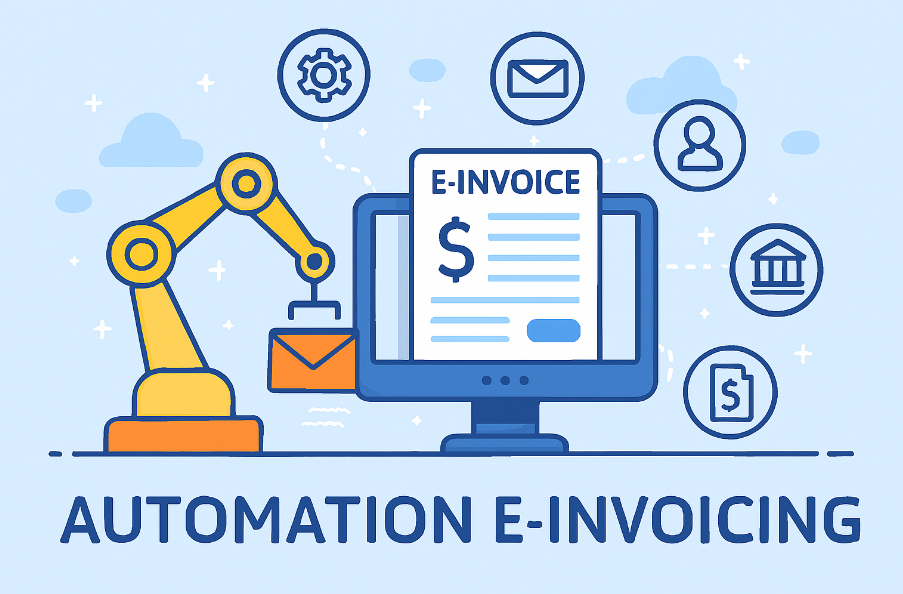
Application Programming Interface (API) Integration for E-Invoicing
The application programming interface plays a major role in automated e invoicing. API allows billing systems, ERP platforms, POS systems, and accounting tools to communicate with the MyInvois system and submit invoices for validation automatically.
API integration eliminates manual submission and reduces non compliance risks caused by data entry errors. Many e invoicing platforms provide a software development kit to speed up integration with existing systems. For SMEs, using a ready-made API solution like Caltrix ensures seamless connectivity with Xero and automated validated e invoice processing.
API-based integration supports businesses issuing high volumes of invoices, ensuring accurate transactions and minimal disruptions.
Direct Integration with MyInvois: Why SMEs Should Automate Validation
Direct integration ensures that invoices flow seamlessly from billing systems to LHDN validation servers. SMEs adopting direct integration gain access to automated invoice validation, error handling, and invoice status tracking. This reduces workload, improves the accuracy of issuing e invoices, and eliminates delays caused by manual submissions.
For businesses with multi-branch operations, project-based billing, or recurring subscription billing, direct integration through Caltrix provides a reliable way to ensure compliance with minimal disruption.
E-Invoicing Security and Data Protection
Security and data protection are at the heart of Malaysia’s e invoicing framework. The Inland Revenue Board of Malaysia has established strict measures to safeguard the integrity and confidentiality of e invoices, including the use of digital signatures and advanced encryption protocols. These features ensure that every e invoice issued and received is authentic, tamper-proof, and protected from unauthorized access.
For businesses, it is essential to implement e invoicing systems that comply with these security standards. This means safeguarding sensitive customer and financial data, regularly updating software, and training staff on best practices for data protection. By prioritizing security, businesses can reduce the risk of non compliance, prevent data breaches, and maintain the trust of their clients and partners. Adhering to these standards not only fulfills regulatory requirements but also strengthens overall business resilience in the digital age.
E-Invoicing and International Trade
E invoicing plays a pivotal role in facilitating both domestic and international transactions for Malaysian businesses. The e invoicing mandate extends to cross border trade, requiring companies to issue compliant e invoices for all international transactions. To meet these requirements, businesses must ensure their e invoicing systems support recognized standards such as the Universal Business Language (UBL) 2.1, which streamlines data exchange and reduces the risk of errors.
By adopting e invoicing for international transactions, businesses can benefit from faster processing times, improved data accuracy, and easier reconciliation. Additionally, companies engaged in cross border trade may be eligible for accelerated capital allowance and other tax incentives, further supporting their growth and competitiveness. Ensuring compliance with the e invoicing mandate for both domestic and international transactions is essential for businesses looking to expand their reach and operate efficiently in the global marketplace.
Accelerated Capital Allowance for E-Invoicing: Tax Incentives You Should Claim
Businesses adopting digital invoicing technologies can claim accelerated capital allowance benefits on ICT equipment, software purchases, and digital infrastructure investments. This incentive supports Malaysia’s push for a stronger digital economy and encourages businesses to upgrade their systems for e invoicing requirements.
SMEs using this allowance reduce their taxable income while achieving compliance with e invoicing mandatory rules. Claiming accelerated capital allowance is especially beneficial for businesses needing to replace outdated billing systems or integrating API-based submission tools.
Consolidated e invoices for High-Volume SMEs: How They Support Compliance
Businesses with high-volume B2C transactions may issue consolidated e invoices instead of individual submissions. Consolidated e invoices allow businesses to summarize daily receipts and streamline billing processes while meeting e invoicing mandatory requirements.
This method supports smoother transition for retailers, smaller businesses, and medium sized enterprises that rely on POS systems. By using e invoicing platforms such as Caltrix, businesses can automatically generate consolidated e invoices and maintain full compliance with LHDN requirements.
Consolidated e invoices support data accuracy, reduce manual workload, and ensure compliance under Malaysia’s updated e invoicing regulations.
E-Invoicing and Sustainability
E invoicing is not only a regulatory requirement but also a step forward in promoting sustainability within Malaysia’s digital economy. The government intends to encourage businesses to implement e invoicing as a way to reduce reliance on paper-based processes, minimize waste, and lower their environmental impact. By transitioning to digital invoices, businesses can significantly cut down on printing, mailing, and storage costs, while also supporting broader environmental goals.
Adopting e invoicing demonstrates a commitment to sustainable business practices and aligns with the government’s vision for a greener, more efficient economy. As more businesses embrace digital invoicing, the collective impact on resource conservation and waste reduction will contribute to a more sustainable future for Malaysia.
E-Invoicing and Risk Management
Implementing e invoicing is a powerful tool for managing risks associated with traditional invoicing, such as errors, fraud, and non compliance. The digital nature of e invoices provides a clear, traceable audit trail for every transaction, making it easier to detect discrepancies and resolve disputes. The e invoicing regulations set by the Inland Revenue Board of Malaysia require businesses to maintain accurate records and follow updated e invoice guidelines, reducing the likelihood of enforcement actions.
By integrating robust e invoicing solutions and adhering to regulatory standards, businesses can minimize operational risks and ensure smoother implementation. Prioritizing risk management in e invoicing not only helps businesses avoid costly mistakes and penalties but also builds a foundation for long-term compliance and operational excellence.
Conclusion
Malaysia’s transition to a fully digital invoicing environment is accelerating, and SMEs must act quickly to align with updated regulatory expectations. With e invoicing regulatory updates Malaysia defining new standards for invoice validation, compliance, and tax reporting, businesses must adopt tools and workflows that support validated e invoices, consolidated e submissions, debit notes, and credit notes.
Caltrix integrates seamlessly with Xero to provide SMEs with full API integration, validated e invoice automation, consolidated e invoices handling, rejection tracking, project management billing accuracy and also end-to-end compliance services.
Businesses that adopt e invoicing early will enjoy smoother operations, faster billing, fewer manual tasks, and full readiness for 2026 enforcement. Start your compliance journey with Caltrix today, the smarter way to implement e invoicing in Malaysia.

Alfred Ang
Alfred has led the company in helping over 500 SMEs successfully transition to digital platforms. With expertise in cloud accounting software implementation and other tech stacks. Alfred empowers businesses to access real-time, accurate financial data for informed decision-making. As a Chartered Accountant (CGMA, ACMA, and MIA member), he is driven by the mission to streamline traditional accounting processes. Alfred’s accomplishments include winning the Xero Award for Medium Accounting Partner of the Year in 2024.